


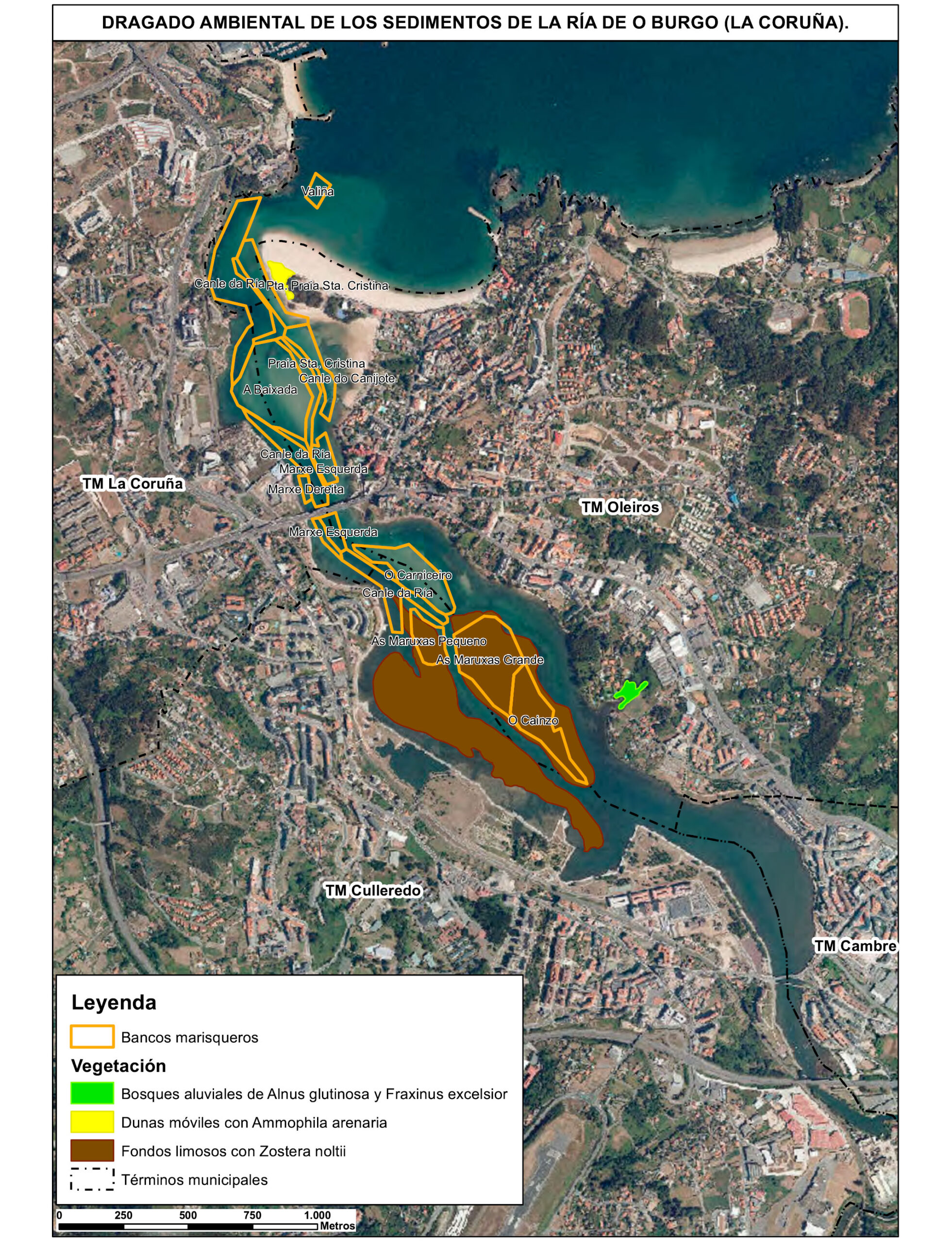
The mouth of the River Mero in A Coruña forms the O Burgo estuary, a beautiful intertidal area that became one of the most polluted coastal zones in southern Europe. Not only because of the accumulation of toxic sludge several meters deep—sludge that has repeatedly endangered the lives of people trapped in the mire; the inner sector of the estuary also holds high concentrations of mercury, copper, lead, arsenic, and zinc, as well as highly carcinogenic hydrocarbons, heavy bacterial loads, and hepatitis A virus in its historic shellfishing grounds.
The catastrophic situation of the O Burgo estuary, located within a metropolitan area of over 400,000 inhabitants, became a matter of great importance, directly affecting four municipalities and escalating from a local problem to regional, national, and European levels. A commission of Members of the European Parliament visited the estuary in 2013, certifying the environmental disaster and urging the authorities to act. It was then—funded by European money—that the environmental dredging project for the sediments of the O Burgo estuary began, under the baton of the Ministry of Environment (and of Agriculture, and of Food, and of Public Works and Transport, or of Ecological Transition, and Demographic Challenge, etc.) with the local promoter being the Coastal Authority of Coruña.
It is worth emphasizing the peculiarity of this particular institution—preferably after a nice stroll along any region of our coastline, which is the most effective way to assess the efficacy of this administrative unit. Fully representative of the Spanish administration, which gets all high and mighty when authorizing a private 2×2 pump shed, yet always looks the other way in the face of the worst environmental atrocities committed in the name of the state. Just to mention a few relevant examples: the construction of the outer port of Ferrol (ecocide No. 1), or the outer port of A Coruña (ecocide No. 2). All, of course, in the name of the common good, which invariably turns out to be the least common of all goods.
From there, a tremendously lengthy administrative process began, involving numerous entities such as the University of Santiago de Compostela, the Center for Studies and Experimentation of Public Works, the Hydrographic Confederation, the Merchant Fleet, the Port Authority, the Spanish Institute of Oceanography, several Governmental Delegations, the regional government Xunta de Galicia (in its many forms and shapes), the Fishermen’s Guild, environmental groups, and so on. These entities produced a series of reports, such as the first Technical Report for dredging the O Burgo estuary (2013), the Archaeological Report (2015), the Environmental Impact Statement (2017), and others, until the project was finally approved in 2020—clearly, lack of time was not the problem. The budget allocated for tendering the project was €48.6 million.
We participated indirectly in this tender process, providing offers to many of the bidding companies and consortia for a technological tool (the Watermaster eco-dredger), specifically designed for this type of intervention, which has already been used successfully in dozens of coastal environmental regeneration projects. Truth be told, with little hope—because in our nearly 30 years of experience, Spanish public procurement is defined by a tangled legislative framework making the process very tortuous, combined with a traditionally corrupt management, fostering opaque contract awards that generally lead to incompetent implementation—but luxurious chalets. Then of course, hundreds of people die in Valencia’s floods, new trains don’t fit in tunnels, highways mysteriously collapse, more than 50 million people suddenly lose power, the much-vaunted Next Generation productive projects get invested in sidewalks… but not to worry, everything is hunky-dory. The project in question was no exception.
Awarded for €26.6 million to Acciona Construcción, in a joint venture with a Balearic company with no experience whatsoever in environmental regeneration projects—but notorious in various cases of political corruption—what could possibly go wrong? After eight years of project assessment, the discrepancy between the budgeted figure (based on all the reports) and the awarded amount (practically half of the budget) already reveals the absurdity of the entire process. Who could be that wrong? Although they naturally try to reduce it to personal responsibility, the mere fact that a contractor with such background remains legally allowed to participate in public tenders in Spain today is a clear reflection of the systemic problem we Spaniards have with the management of our money—and European money as well.
It does not matter if the technical team has never carried out this type of intervention, if the proper machinery is not used, if damage is done to the environment, if project specifications are ignored, if obsolete technology is employed, jeopardizing the entire ecosystem; if 175,000 cubic meters of toxic sludge are buried at the river mouth, if the species listed in the regeneration plan are never planted, if the results of water quality analyses are never published, if shellfish do not breed again or if the sludge remains in the estuary. Should there be protests, we simply fund—again with public money—what has already been squandered, and move on. And then, of course, an official storyteller will come along to tell us “the real truth”, in the voice of his master.
That Spain is different, we already knew—and all this mess is not even the worst of it. Wasting what could have been a benchmark intervention for the desperately needed environmental regeneration of the Iberian Peninsula isn’t the worst either. Nor is the complicit silence of the local press, or that of the ever-rowdy environmental groups—who we repeatedly ask: where were you then, when we needed you most? Nor the fact that the usual crooks think we don’t notice what’s going on, as if we were fools. Not even the proven reality that those who denounce political corruption today behave just as greedily, sectarianly, and tribally the moment they gain power.
Without a doubt, the hardest part is that intimate and necessary conversation at the family dinner table, when you have to explain to your children that in order to get ahead in Spain, a good command of Photoshop is the only truly valuable skill. Forget education, effort, or ability; what they need is to buy from the trendy dealer and spend their afternoons in the brothel, in order to make the proper connections. And by comparison, smearing oneself with that foul sludge, makes the stench of O Burgo’s toxic mud smell like genuine Chanel No. 5.